
How to Grow a Home Care Agency Through Memory Care: 9 Lessons From a Dementia-Focused Agency
Dawn FialaVP of Business DevelopmentNovember 8, 2026
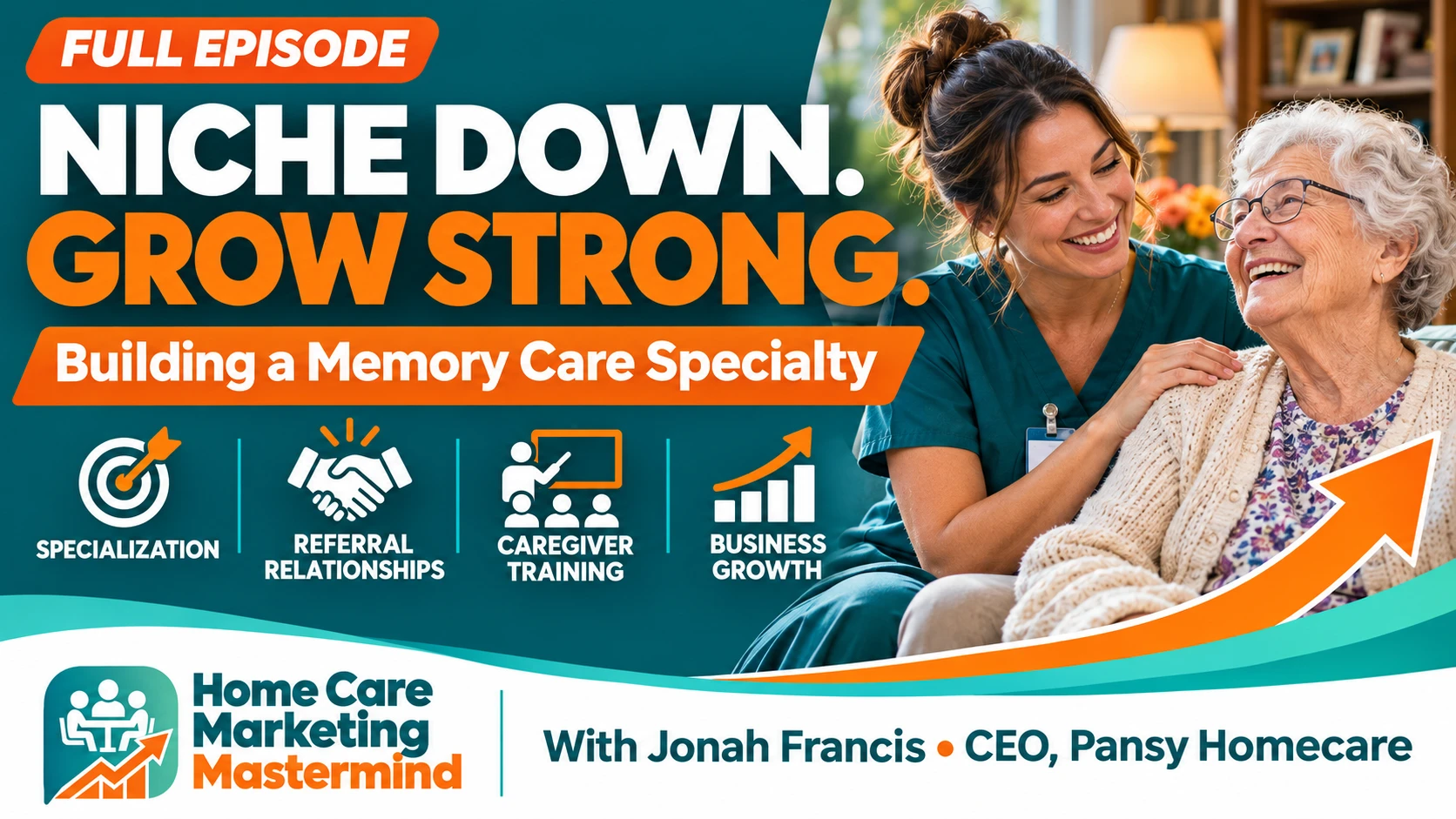
Key takeaway: Specializing doesn't shrink a home care agency. It sharpens it. At our November 2026 GoCarePro® Mastermind, Jonah Francis, CEO of Pansy Homecare, shared how going all in on dementia care rebuilt his agency's training, marketing, and business model. Today 96 to 97% of his census lives with dementia, and clients average 60 billable hours per week. That's more than double the 28-hour industry average he cited from Home Care Pulse / Activated Insights.
Every home care agency says it's different. Very few can prove it. If your website, your referral pitch, and your caregiver training sound like every other agency in town, referral sources have no reason to pick you.
That's why we invited Jonah Francis to the GoCarePro Mastermind. His agency, Pansy Homecare, is a non-medical home care agency in Connecticut built around one specialty: memory care. Here are the nine lessons agency owners can apply, whether or not dementia care is your niche.
Watch the full Mastermind replay
Prefer to listen? The interview is also a podcast episode:
1. Specialization Starts With a "Why," Not a Marketing Angle
Pansy Homecare didn't choose dementia care from a spreadsheet. Jonah's commitment started with an early client living with dementia whom the agency struggled to support. Caregivers came and went. The family had been through other agencies and had started to accept that "this is just how it is."
Jonah didn't accept that. As more of the agency's clients turned out to be living with dementia, the drive to do better grew. In 2020, Pansy Homecare made the decision official and went all in.
Jonah describes the decision as the point "when our hearts and our numbers align." The mission has to be real, and the market has to support it.
Takeaway for owners: Referral sources can tell the difference between a niche you believe in and one you bolted on for marketing. Start with the population you're already serving well and want to serve better.
2. Niching Down Isn't Doing Less
The most common fear about specializing is that you'll turn away business and shrink. Jonah says the opposite happened.
"Niching down isn't about doing less. It just increases your focus on how to do what you're already doing that much better."
Pansy Homecare expected a few things to change. Instead, everything changed: policies, procedures, org structure, caregiver support, and even language. "Care plans" became "partnership plans." The team stopped saying they were "dealing with" clients and started saying they were "working with" and "partnering with" them.
Jonah calls this process operationalizing their SOPs. Start small, let things break, fix them, and only scale what survives real-world pressure. Six years in, they're still refining.
3. Train Beyond the Minimum
Connecticut will require 8 hours of caregiver orientation and training starting in 2027. Pansy Homecare already provides 14 hours in a caregiver's first 30 days: 8 hours of orientation plus 6 hours of continuing education within the first 14 days.
Two training lessons stood out.
Online training often doesn't stick. A union board member who shadows caregivers told Jonah what she sees: caregivers start the online training video on their phone, put it in their back pocket, and go work their shift. That conversation pushed Pansy Homecare to move most of its training in person.
Simple language wins. Pansy Homecare teaches dementia as "brain change and brain failure," using language from Teepa Snow's Positive Approach to Care. As Jonah puts it, if the scientific definition is hard for professionals to remember, caregivers won't remember it either.
4. Aim for "Competent Confidence"
Families of people living with dementia ask one question above all: Do you know what you're doing?
Jonah's answer is a standard he calls competent confidence:
- Some caregivers are confident but not competent.
- Some are competent but not confident.
- The goal is both.
When a caregiver can answer an adult daughter's questions calmly and accurately, Jonah calls it "a game changer for her." That moment builds trust with the family and, eventually, with the referral source who sent them.
Jonah also stressed that no amount of training eliminates hard moments. Every caregiver will need support "when stuff hits the fan," and agencies have to be ready to back them up in real time.
5. Build a Care Model Families Can Feel
Pansy Homecare's Purpose Filled Care™ model gives the agency a story that sets it apart. It rests on two ideas:
- Moments That Matter: small, everyday moments on every shift that help a client feel dignified and connected to their caregiver. These are documented every shift and checked monthly.
- Legacy Moments: bigger experiences that give families a memory of their loved one beyond the dementia. In one case, a care coordinator arranged for the zoo to bring a penguin to a 100-year-old client who had always loved penguins and never seen one in person.
Marketing lesson: Stories like these do more for referral relationships than any brochure. They show your values instead of claiming them.
6. Being "Dementia Focused" Beats Having a "Dementia Program"
Plenty of agencies advertise a dementia specialty program. Jonah draws a sharp line between a program and a focus.
A specialty program usually means a select few caregivers took a one-hour course, and you hope they're available when a dementia case comes in. A dementia-focused agency means almost every client, process, and caregiver is built around that population. At Pansy Homecare, that's 96 to 97% of the census at any given time, compared with 50 to 70% at a typical agency.
Jonah summarizes the caregiver standard as ASA: Approach, Skill, and Ability. As he asks, who couldn't benefit from a caregiver with a heightened level of all three?
7. Referral Marketing: Presence Wins
Jonah's referral philosophy is simple:
"Presence wins. Showing up wins."
You need reasons to show up, a plan for when you show up, and a clear idea of what to do once you're there. Then you have to actually show up, consistently. If you aren't in front of your referral sources, they'll forget you or feel the love from someone else.
What Pansy Homecare does:
- Builds visits around education. The agency runs an education calendar for referral partners.
- Defines small wins for the first five visits with a new referral source. This takes pressure off business development reps and gives every visit a purpose.
- Targets the right sources. Their strongest referral sources include dementia consultants and trainers, geriatric care managers, and elder law attorneys.
- Leads with community. "People only care what you're doing once they know that you care about them."
- Runs 10 lunch and learns per quarter, without "water hosing" anyone. Share bits and pieces, and always leave a reason to come back.
Approved Senior Network also built Pansy Homecare's website around memory care, with SEO, blog content, and newsletters all focused on that specialty. Your online presence should tell the same story your business development team tells in person. For the in-person side, our referral development training teaches business development reps to plan visits the same way, and our list of home care referral sources covers who to put on the route.
8. Do the Math Before You Pick a Niche
Before committing to a specialty, Jonah recommends due diligence on market size:
- Find a statewide estimate. Connecticut had about 91,000 people diagnosed and living with dementia as of 2025.
- Filter it down to your county. If no local number exists, use CDC, Alzheimer's Association, or similar data and map it down.
- Count your 65+ population, since older adults carry a higher likelihood of dementia.
The same approach works for other specialties, such as Parkinson's, post-hospital recovery, or veterans' care.
9. Design the Business Around the Niche (and Know Your Numbers)
Specialization reshaped Pansy Homecare's business model:
- Higher hours per client. Clients average 60 billable hours per week, versus a 28-hour industry average.
- Weekly minimums. The agency set hour minimums around the time it went dementia focused, because short shifts had the highest failure rates and didn't fit its full-time caregiver pool. It also tracks the ratio of full-time to part-time cases.
- Intentional mission cases. The agency caps how many lower-margin cases (such as certain state and PACE program cases) it carries at once. That way it can say yes to mission-aligned work without hurting the business.
- A caregiver playbook. Pansy Homecare had playbooks for every role except caregivers. Now caregivers learn up front what success looks like. Their three core jobs are care and safety, engagement every day, and supporting the family.
- Two clients, not one. In dementia care, the person paying and making decisions is usually a family member. Caregivers are trained to communicate with and support the family, not only the client.
- Paid exits from orientation. When a new hire clearly isn't a fit, Pansy Homecare pays them for their time and asks them to leave. This makes the conversation easier and protects clients.
- Transparency with families. Telling families honestly what the agency can and can't do avoids service failures and protects relationships with referral partners.
Jonah closed with his biggest warning. In one review of about 400 clients served over time, only 89 were profitable. As a former financial analyst, he calls it one of his most important lessons. It's fine to take on lower-margin clients for mission reasons, but know your break-even point before you say yes.
Your Next Step
Specialization isn't a limitation. It's your strongest competitive advantage. But a niche only pays off when the right people know about it: families, referral sources, and caregivers.
Approved Senior Network helps private duty and home care agencies build that visibility through home care marketing: websites, SEO, content, and referral development built around their specialty.
Ready to turn your agency's niche into referrals? Talk to our team.
Frequently Asked Questions
What is a home care agency niche?
A home care agency niche is a specific population or service you build your agency around, such as dementia care, Parkinson's, or post-hospital recovery. A true niche shapes your training, processes, marketing, and referral strategy. A side program offered by a few staff members isn't the same thing.
Will specializing in memory care shrink my home care business?
Not necessarily. In Pansy Homecare's case, specializing in dementia care was followed by record growth and an average of 60 billable hours per client per week. Do market research first to confirm there's enough demand in your service area.
How do I know if my market is big enough for a specialty?
Start with state-level prevalence estimates for the condition, filter them down to your county, and look at your local 65+ population. Sources like the CDC and the Alzheimer's Association can help when local numbers aren't published.
What's the difference between a dementia program and a dementia-focused agency?
A dementia program usually trains a few caregivers for dementia cases. A dementia-focused agency builds nearly all of its training, care planning, communication, and hiring around people living with dementia, so every caregiver is prepared.
Who are the best referral sources for memory care home care?
Pansy Homecare's strongest sources include dementia consultants and trainers, geriatric care managers, and elder law attorneys. The right mix depends on your market, so track where your referrals come from and invest in the relationships that convert.
How many lunch and learns should a home care agency hold?
Pansy Homecare targets 10 lunch and learns per quarter, based on its own history. Rather than presenting everything at once, share a focused topic and leave referral partners a reason to invite you back.
Should home care agencies require weekly hour minimums?
Many agencies set minimums to protect caregiver consistency and reduce service failures, which often concentrate in short, part-time shifts. Review your own numbers, such as failure rates by shift length and your caregiver pool's preferences, before setting a policy.
How can marketing help a home care agency stand out with a specialty?
Your website, SEO, content, and referral outreach should all tell the same specialty story. When families search online and referral sources check you out, they should see consistent proof of your expertise. That consistency builds trust faster than generic home care messaging.